Using Off-Site Construction to Close the Affordable Housing Gap

As the number of cost-burdened households swells and the price per unit of constructing new housing balloons across the US, off-site construction offers community-based organizations (CBOs) a compelling way to build high-quality and often well-designed affordable housing in less time and at a reduced cost.
A new paper summarizing research I did as a 2024 Gramlich Fellow in Community and Economic Development examines the experiences of six CBOs that have used off-site construction to create new affordable housing ranging from single-room occupancy units for formerly unhoused residents to single-family for-sale homes on community land trust plots. Drawing on conversations with developers, researchers, government officials, architects, manufacturers, and residents, I review key outcomes—total development costs, construction timelines, and design quality—as well as factors that contributed to them, including team coordination, relationships with government officials, and design decision-making processes.
For most of the developments, the application of off-site construction techniques over conventional methods minimized construction timelines, lowered overall costs, or both. Contrary to common perceptions that factory-built housing is inherently uniform in its design and detailing and that such inflexibility limits the contexts for which it is architecturally suitable, the projects featured in the paper exhibit a surprisingly broad array of stylistic and formal attributes. In several cases, this adaptability enabled architects and developers to tailor buildings to the neighborhoods in which they are sited.
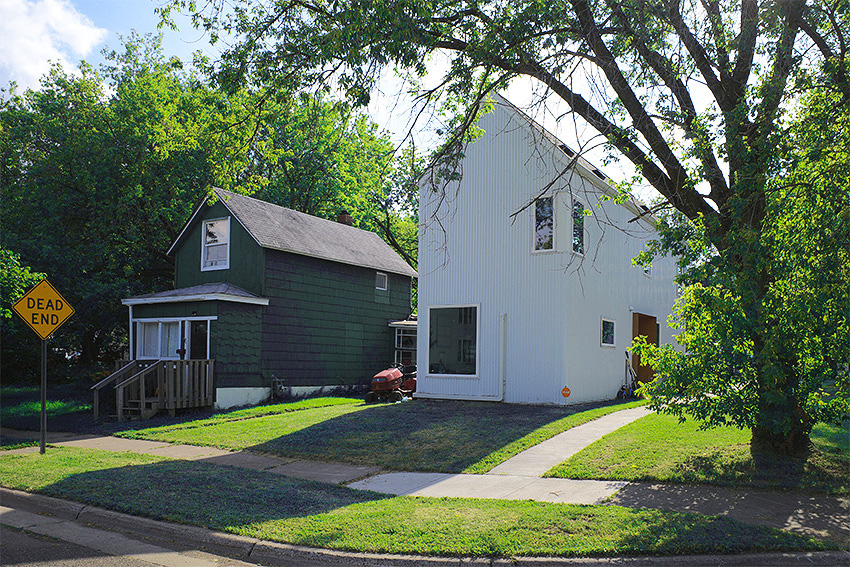
Panelized homes designed for narrow lots in Duluth, Minnesota, mirror some existing residential architecture. Photo: Aaron Smithson.
However, the financial and time savings associated with off-site construction are not guaranteed. Rather, stakeholders underscored important strategies to make this method work. Most notably, I found that leaders of CBOs interested in using off-site construction to create new affordable housing should:
- Understand how off-site construction might help a CBO advance its mission. Off-site construction presents many advantages over conventional building methods for organizations that aim to meet urgent affordable housing needs, minimize broader environmental impacts, and maintain strong relationships with their communities. Reflecting on how the potential benefits of modular or manufactured housing align with CBO goals is a vital first step in developing an effective implementation strategy.
-
Be deliberate about where and how to implement different forms of off-site construction. Examining a project’s architectural context, the available manufacturers in the region, the logistical complexity of transporting and assembling components on-site, and the local regulatory environment for both modular and manufactured housing are critical steps in realizing cost and time savings. No single approach to off-site construction is right for all infill sites.
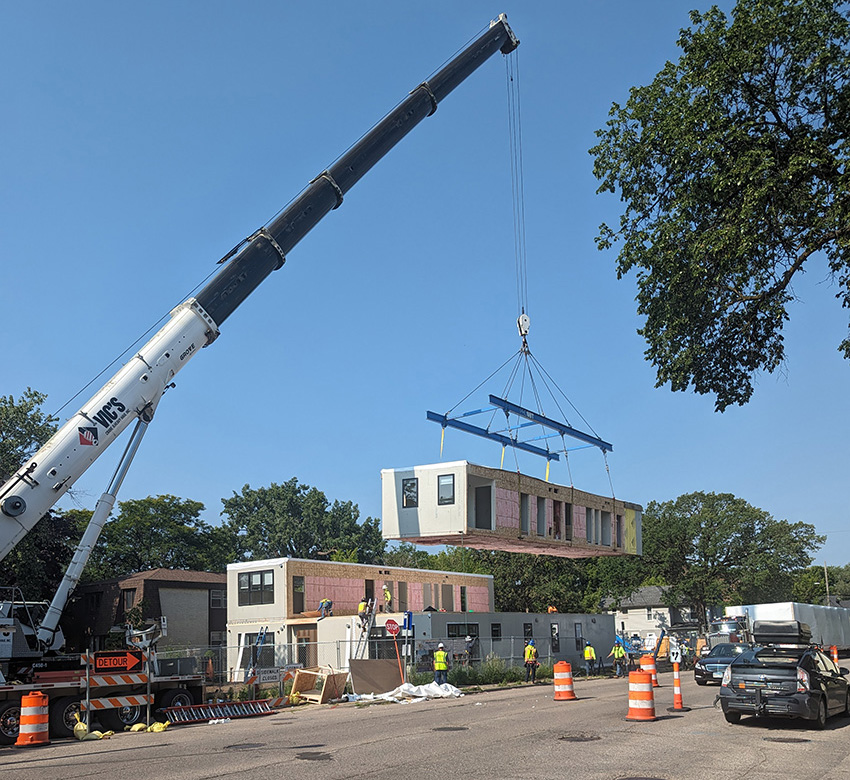
Minneapolis Public Housing Authority's scattered-site buildings were assembled one by one, with crews moving from site to site over several weeks. Photo: Courtesy DJR.
- Coordinate development teams from the outset. Early collaboration among developers, architects, manufacturers, and general contractors reduces costly revisions and mistakes later in the construction and assembly process. CBOs stressed the importance of bringing on architects and manufacturers simultaneously, emphasizing that off-site construction is a precision game. Even with the transport expertise of manufacturers and installers, logistics are especially complex for scattered-site infill projects, prompting some interviewees to suggest developing fewer sites simultaneously and dedicating a separate lot for material staging.
-
Explore customization and design expression. Many of the designers and developers interviewed noted initial surprise with the level of design expression now possible in off-site construction and encouraged other CBOs and architects to learn from the expertise of manufacturers and installers. From wider varieties of exterior cladding to creative roof pitches, many architectural features often associated with conventional buildings can now be applied to their prefabricated counterparts.
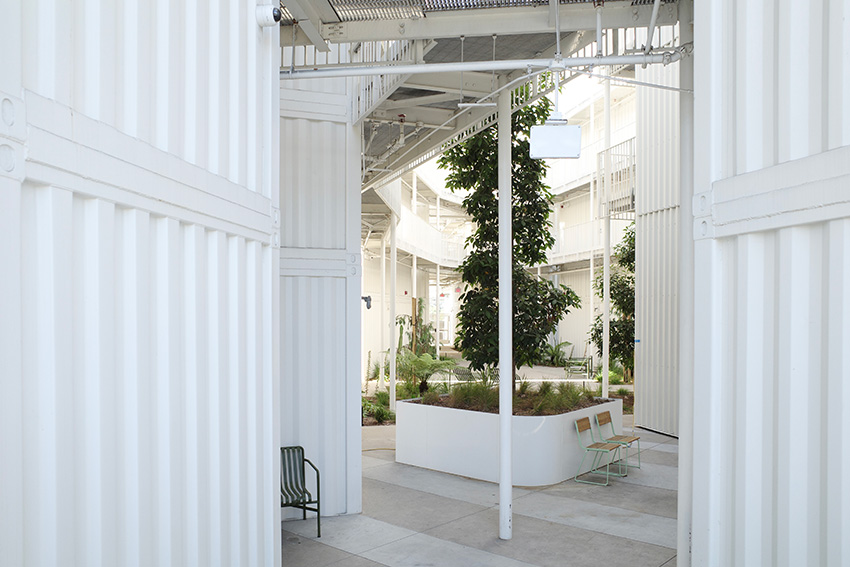
Holos Communities' Isla Intersections project in Los Angeles is centered on a ground-floor courtyard and open-air walkways on each upper floor. Photo: Aaron Smithson.
- Engage, educate, and share. While some CBOs worked with local government officials who actively encouraged the adoption of off-site construction methods, others had to educate leaders on the potential benefits. Advocacy for a fairer regulatory environment for manufactured housing and more responsive lending practices for modular housing, as well as information sharing among development teams, can help cultivate a more mature and diverse off-site construction industry nationwide. As the industry scales and institutional familiarity with and regulatory acceptance of off-site construction methods grow, the technique is more likely to have a substantial and sustained impact on housing affordability across the US.
In sum, while factory-built housing is not a panacea for the high construction costs that currently inhibit affordable housing production in the US, the experiences detailed in the paper’s case studies make clear that under the right conditions it can help deliver high-quality, well-designed housing faster and a lower price point than conventional methods.
Cover photo: A fourplex built from volumetric modules on a site owned by the Minneapolis Public Housing Authority. Photo: Aaron Smithson.


