Learning From Recent Efforts to Create Limited Equity Housing Cooperatives

Seattle-based group Frolic works with owners of single-family homes in neighborhoods that have recently been upzoned to redevelop their property into multiunit LECs. Designed and co-developed by Allied8 Architects, homes within the 10-unit Corvidae Co-op are organized around a shared courtyard. Photo: Rafael Soldi.
As the unflagging challenge of housing affordability spreads to all corners of the country, novel efforts to increase the prevalence of limited equity cooperatives (LECs) are getting underway. Long a model most associated with a handful of Northeastern markets, this new interest spans an array of cities in many different parts of the country, with projects taking shape in places as diverse as Missoula, Nashville, Seattle, and Portland, Maine.
In a new paper, completed as part of my 2025 Gramlich Fellowship in Community and Economic Development, I review the approaches, outcomes, and challenges for several of these recent projects. The paper, which draws on interviews with more than two dozen individuals possessing a combination of project-specific and sector-wide expertise, as well as a review of the literature on LECs and project-related materials, hopefully will be a useful resource for practitioners and others exploring LECs as a prospective solution to ongoing housing challenges.
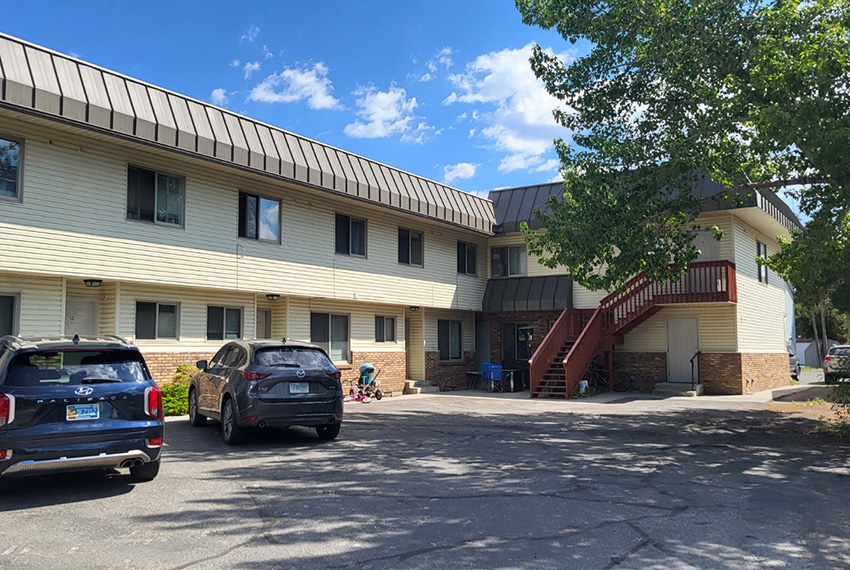
Gibbon Avenue Apartments is an 18-unit complex in West Yellowstone, Montana. After it was listed for sale, NeighborWorks Montana and Human Resource Development Council helped residents purchase the building and convert it into a limited equity cooperative. Photo: NeighborWorks Montana.
Key findings include the following:
-
There is not “one” model. Practitioners have recently sought to create LECs in several different ways, including converting privately owned rental buildings; redeveloping infill lots; rehabilitating and then converting distressed, city-owned properties; and constructing large, entirely new buildings. These initiatives have aimed to address various housing challenges, such as the loss of naturally occurring affordable housing or an inaccessible homeownership market. In some instances, projects are initiated in response to resident organizing or destabilizing events (e.g., property sales), while others are spurred proactively by policymakers or practitioners drawn to the model. Local goals and available resources ultimately result in projects taking markedly different forms from one another in terms of financing strategies, affordability targets, and other defining features. Together, this variation underscores the absence of a single, standardized approach.
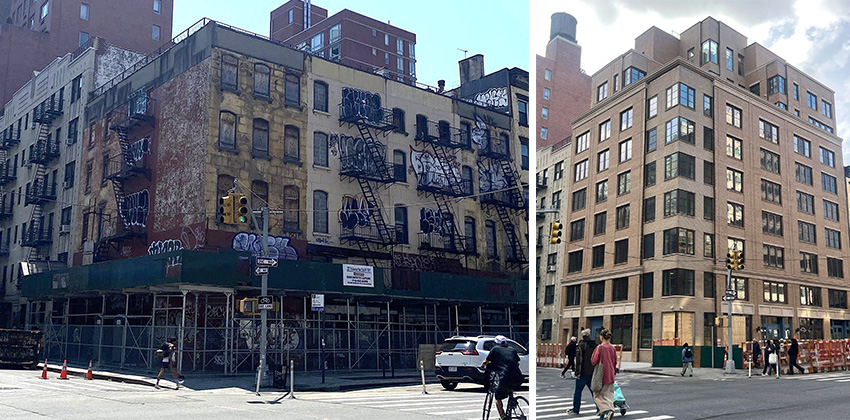
In New York City, the organization Asian Americans for Equality has led multiple cooperative conversion projects through the city’s Affordable Neighborhood Cooperative Program. Most recently, this included transforming a partially occupied building in Chelsea with structural issues (left) into a newly constructed 23-unit building (right). Photos: Asian Americans for Equality.
- To date, results are mixed. Not all efforts have succeeded, with large new construction projects appearing to have encountered the greatest obstacles. Practitioners describe complications financing such projects in Seattle and Portland, Maine, where groups are seeking to build LECs ranging from 68 to 90 units in size. Subsidies do not go as far due to high development costs, and interviewees report challenges accessing construction financing for such unconventional projects. While the groups leading these efforts both sought to secure funding through HUD’s Section 213 construction-to-permanent financing program, one group ultimately walked away and the other has not yet been able to close. More generally, many of the most advanced initiatives so far involve relatively small properties, often containing fewer than two dozen units.
- Projects often depend on acquisition and financial support. Flexible acquisition timelines have repeatedly played a crucial enabling role. Several practitioners have, for instance, relied on partnerships with public agencies to hold and provide sites for LEC projects. Meanwhile, in acquisitions of privately owned buildings, practitioners are often relying on interim ownership or special arrangements with sellers (e.g., an extended acquisition timeline) that create a cushion of time to assemble financing and prepare residents to assume cooperative ownership. Practitioners also consistently reported that some form of financial assistance, such as grants or low-interest loans, was needed to ensure that projects were affordable, even for moderate- and middle-income households.
- Comprehensive support and oversight arrangements are common. To promote long-lasting housing security and affordability, practitioners have utilized several strategies. Among the most popular is combining LECs and community land trusts (CLTs). By continuing to own the land and issuing a long-term ground lease to the cooperative, the CLT structure keeps supportive practitioners nearby and codifies the conditions under which a steward can step in to take corrective action. Those experienced in this stewardship role describe bringing multiple kinds of expertise to these projects, including property operation, asset management, and cooperative governance.
- Asset building and affordable monthly costs are important but challenging goals. Asset building opportunities generally require that residents invest more than a modest sum to join an LEC. However, many lower-income households do not have the needed funds and cannot qualify for a large loan. Consequently, most projects serving lower-income households require only a small initial investment that is unlikely to increase much in value. Even so, compared to rental housing, the model increases resident control and eliminates uncertainty, and several practitioners shared anecdotes of residents expressing satisfaction with these aspects of LEC housing. But housing costs can and do increase for some residents, most notably in rental-to-cooperative projects, resulting from the cost of acquisition and capital repairs as well as the need to equitably allocate monthly charges across households. Dynamics like these are why one practitioner interviewed for this project said LECs may sometimes simply be “the best of bad alternatives” for residents.
Taken together, these findings surface several practical considerations those considering an LEC must confront. While appealing, LECs cannot address all housing challenges, and projects tend to require a relatively uncommon mix of enabling conditions, including motivated residents, organizational capacity, adequate financing, and long-term support. Still, the case studies in this paper make clear that LECs can serve as a valuable tool under the right conditions by creating opportunities for long-term housing stability, meaningful asset building opportunities, and resident empowerment.


