Process Matters: How Design Competitions Improve Housing Quality and Build Capacity

Cities and states are increasingly aiming to use public land for housing production. The most widespread forms of competitive bidding for public land are requests for qualifications (RfQ) and requests for proposals (RfP) directed at developers, to whom architects act as consultants. Accordingly, these processes prioritize the experience and financial standing of developers over the quality of urban and building design. Minimizing public expenditure while maximizing unit count is often the key consideration in the awarding of land.
One issue with current public procurement practices is that only large and established development and design firms can afford the lengthy and uncompensated process. This excludes emerging talent from a fair chance at public contracts. Additionally, the lack of incentives to prioritize design quality leads to the replication of existing housing types, and the often untransparent awarding of contracts complicates trust in government-led processes.
In a new working paper, “Designing Procurement: The Case for Competitions,” I argue for separating the selection of a developer from the selection of a design team if public support for housing is to lead to more diverse housing forms and higher construction quality. But there are additional benefits to using design competitions in procurement: they can promote public engagement, create trust in government-led efforts, and build capacity in the public and private sectors.
Design competitions are a different way to procure design services for housing. Competitions are directed at architects, independent of the search for a development partner (which can happen before or after the competition). A successful competition requires a well-vetted project brief, which must take into consideration public engagement and financial feasibility. Competitions lead to higher quality design due to both competition and choice, and allow for the comparative evaluation of urban design and architectural proposals. They create opportunities for emerging firms, and build capacity in the public sector which is tasked with writing a binding bid document as the basis for the competition.
Figure 1: Small Lots, Big Impacts competition, selection of prize-winning proposals, 2025

Cities across the United States have attempted to entice developers to build housing on small, publicly owned sites by organizing design competitions. To date, none of these processes have led to commissioning architects or implementing proposals. It remains to be seen whether the winners of UCLA cityLAB’s smartly crafted, ongoing process, shown here, will prove skeptics otherwise.
Courtesy: UCLA cityLAB
In the paper, I analyze the shortcomings of existing procurement processes by examining how Chicago, New York City, and Atlanta have recently disposed of public land for affordable housing. I then analyze a series of design competitions that were organized specifically for small sites in Boston, Chicago, Los Angeles, and New York City. Each launched with an “ideas competition,” one drawing over 300 submissions. However, to date, not a single architect who won an award was subsequently commissioned. Why this disconnect between a design competition’s promise of innovation and the reality of who gets hired and what gets built? Interviews with architects, developers, and public officials reveal a faulty understanding of architectural replicability, a lack of political commitment to these processes, and hurdles in public procurement rules.
Figure 2: In der Wiesen Süd, Vienna, completed 2017, exterior view
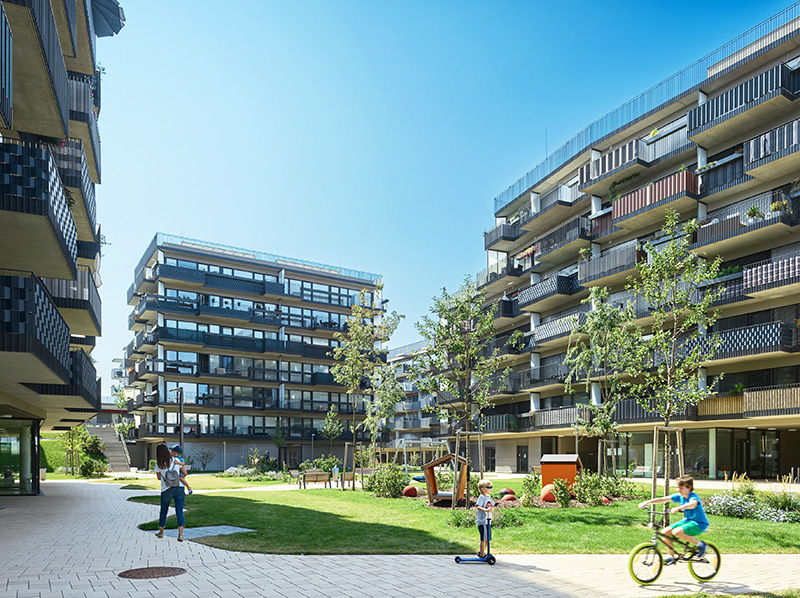
Since the mid-1980s, Vienna has been buying land and marking it down for the development of social housing. Since 1995, it has used a developer competition (Bauträgerwettbewerb) to award this land in conjunction with guaranteed low-cost financing to winning proposals. Proposals are evaluated by an independent jury on the basis of established criteria; building and urban design, as well as financial feasibility, are key parts.
Heimbau Gemeinnützige Bau-, Wohnungs- und Siedlungsgenossenschaft, developer; Dietrich Untertrifaller Architekten GmbH, architects.
Courtesy: Bruno Klomfar.
The paper then describes how public entities in Zurich, Vienna, and London organize access to public land for housing in tandem with competitive design selection processes. While the professional cultures, politics, and policy frameworks in the European cities are distinct—and differ from constraints in the US—they provide examples of processes that could easily be adopted to elevate design excellence and construction quality in housing.
I conclude with five actionable recommendations for cities and states to move in the direction of using design competitions to build higher quality housing on public land.
Designing procurement to include architecture competitions is an opportunity to ensure new housing that will inspire and last; will respond to and serve increasingly diversifying needs; and, perhaps most importantly, reinvigorate public engagement with and trust in public processes.
Cover image: Colville Estate masterplan, London, public engagement, c. 2011
In 2009, Karakusevic Carson Architects was appointed, through a competition process, to develop a mixed-used masterplan for a 4.1-hectare site, replacing 438 existing homes with 935 new apartments for a range of households, tenures, and incomes. The planning contract involved extensive public engagement. Architects for individual buildings were then selected via additional competitions.
Courtesy: Karakusevic Carson Architects.


