Living Longer with Less: The Financial Burdens on Older Women

Over the past decade, the number of older women who rent or own their homes has risen by 37 percent—an increase 7 percentage points higher than that of households headed by older men. Yet despite this growth, older women who are household heads are more likely to live alone, more likely to rent rather than own, and more likely to have lower incomes. They also face higher rates of housing cost burden than their male counterparts.
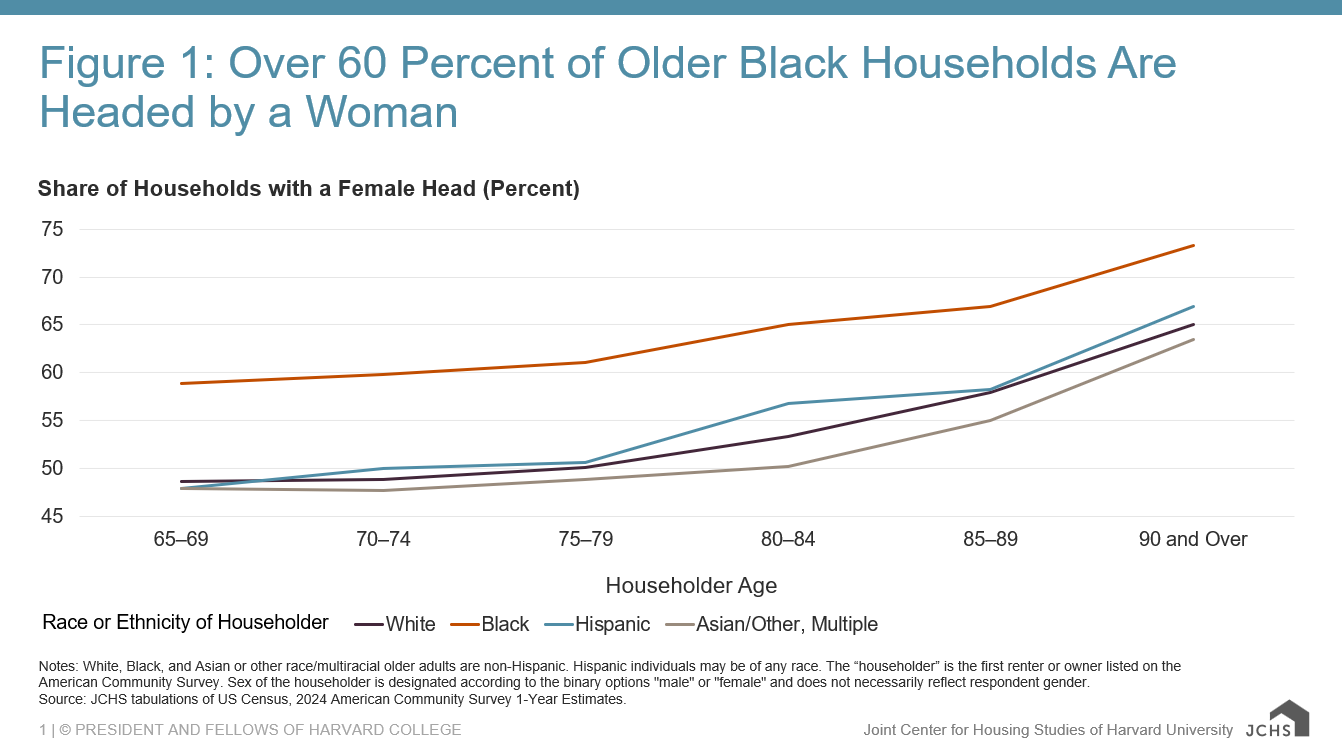
Today, nearly 20 million women age 65 or older are heads of households, and women account for two-thirds of householders in their 90s, according to our analysis of the 2024 American Community Survey. Because women in the US live longer on average than men, they are increasingly likely to become household heads in later life. But these patterns vary sharply by race and ethnicity. Older Black household heads are the most likely to be women (61 percent), rising to 73 percent among those age 90 or older. In contrast, older Asian households have the lowest share of female heads (45 percent), such that Black women ages 65 to 69 have female headship rates comparable to Asian women in their 90s (Figure 1).
Figure 1: Over 60 Percent of Older Black Households Are Headed by a Woman
Notes: White, Black, and Asian or other race/multiracial older adults are non-Hispanic. Hispanic individuals may be of any race. The “householder” is the first renter or owner listed on the American Community Survey. Sex of the householder is designated according to the binary options "male" or "female" and does not necessarily reflect respondent gender.
Source: JCHS tabulations of US Census, 2024 American Community Survey 1-Year Estimates.
Older women are more likely to live alone, and many are living with disabilities
Of the 16 million older adults who live alone, 10 million are women. This raises concern about loneliness and isolation as well as access to care since professional care at home is unaffordable to most. After age 74, nearly half of women and men living alone have difficulty with self-care, independent living, mobility, memory, hearing, or sight. In 2024, nearly 4 million women and 2 million men lived alone with at least one disability.
Households headed by older women have roughly two-thirds the income of those headed by older men
It can be expensive to manage disabilities and chronic health conditions. Yet the median income of older female-headed households ($48,000) is roughly two-thirds that of male-headed households ($71,000). This gap widens with age: after 79, the median income of households headed by women ($36,000) falls to just 60 percent of that of households headed by men ($60,000).
Since median income falls with age, the oldest households have the least. The 960,000 women 90 or older who head a household have a median income of $32,000. Income is even lower for the 4.8 million female renters 65 and older ($27,000), who lack home equity and often pay market-rate rents. Yet the majority (60 percent) of older renters are women.
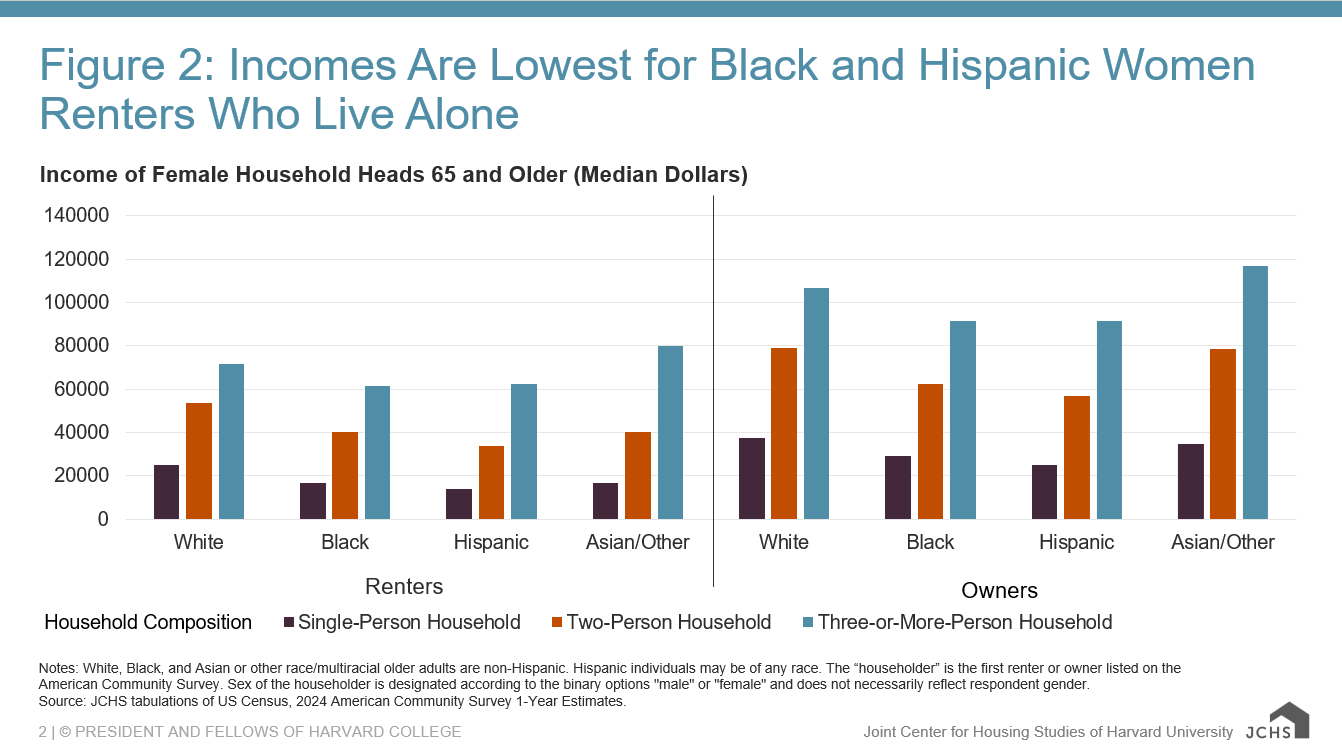
Household composition also matters. Older women who live alone have less than half the income ($31,000) of those living with a partner ($72,000). Finally, Black ($37,000) and Hispanic ($36,000) women who head households in later life have much lower median incomes than white ($51,000) or Asian ($49,000) women. These disparities compound, so female renters 65 or older who live alone have shockingly low incomes, with a median of just $14,000 for Hispanic and $17,000 for Black and Asian or multi-race households (Figure 2).
Figure 2: Incomes are Lowest for Black and Hispanic Women Renters Who Live Alone
Notes: White, Black, and Asian or other race/multiracial older adults are non-Hispanic. Hispanic individuals may be of any race. The “householder” is the first renter or owner listed on the American Community Survey. Sex of the householder is designated according to the binary options "male" or "female" and does not necessarily reflect respondent gender.
Source: JCHS tabulations of US Census, 2024 American Community Survey 1-Year Estimates.
Half of the oldest women householders—and 60 percent of those who rent—are burdened by high housing costs
Because they have lower incomes, higher rates of renting, and are more likely to live alone, 39 percent of older female-headed households face housing cost burdens or severe burdens—spending at least 30 to 50 percent of their income on housing. This compares with 28 percent of older male households.
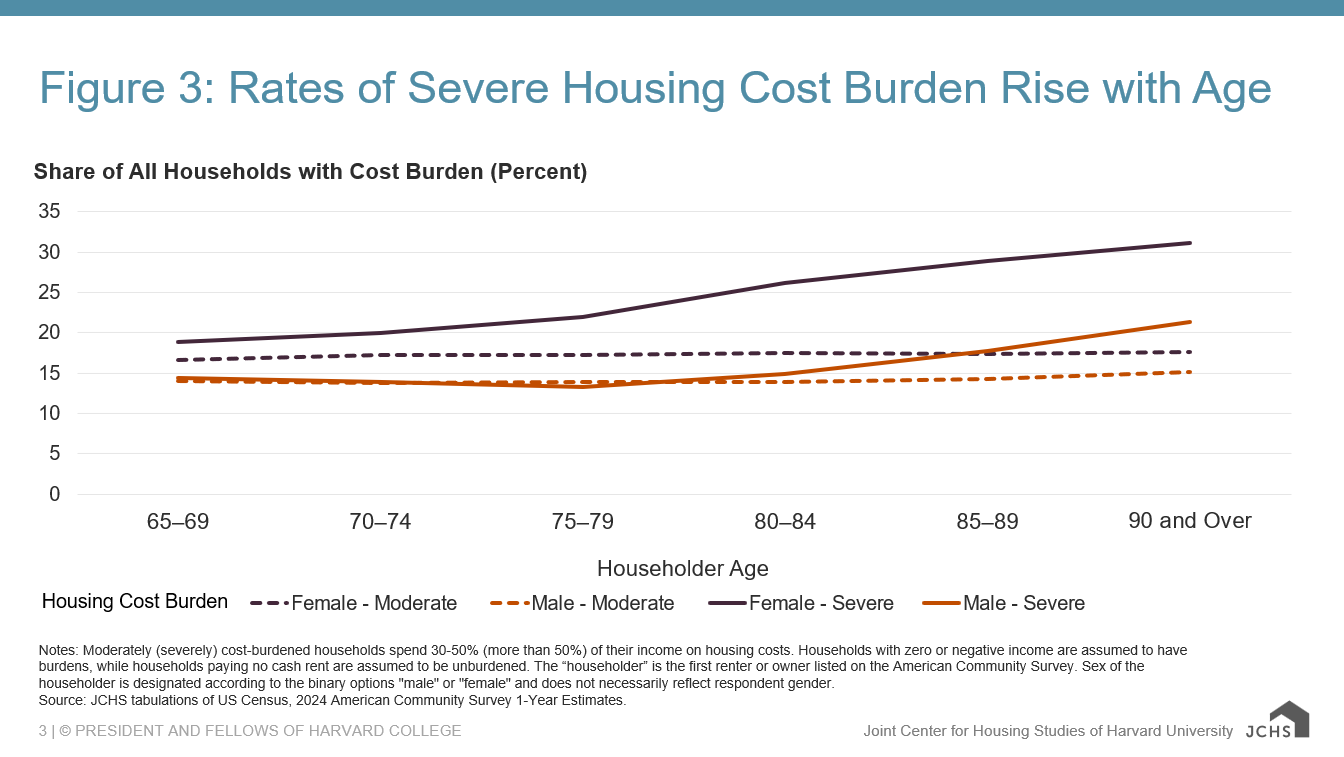
Housing cost burdens are often linked to housing instability and difficult trade-offs between paying for housing and covering other essentials like food and medicine. Housing cost burden rates rise with age—and remain consistently higher for female-headed households than for male-headed ones. After age 89, nearly half (49 percent) of women householders are cost burdened, compared with 37 percent of men. Even more troubling, these age-related increases are driven largely by a growth in severe cost burdens (Figure 3).
Figure 3: Rates of Severe Housing Cost Burden Rise with Age
Notes: Moderately (severely) cost-burdened households spend 30-50% (more than 50%) of their income on housing costs. Households with zero or negative income are assumed to have burdens, while households paying no cash rent are assumed to be unburdened. The “householder” is the first renter or owner listed on the American Community Survey. Sex of the householder is designated according to the binary options "male" or "female" and does not necessarily reflect respondent gender.
Source: JCHS tabulations of US Census, 2024 American Community Survey 1-Year Estimates.
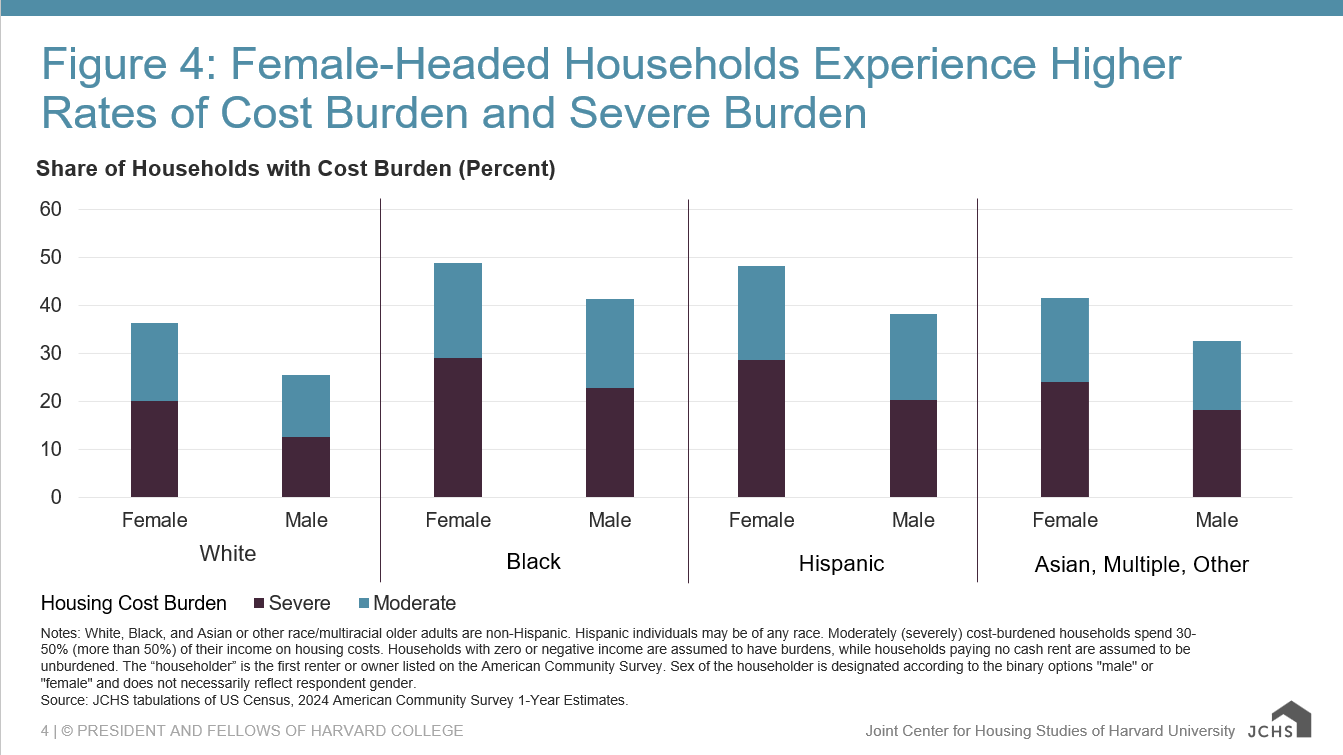
Cost burden rates are also higher for renters. Half of female renters 65 or older experience cost burdens, which is 9 percentage points higher than for older male renters. Rates are particularly high for women renters living alone (66 percent). While white households are the most likely to live in housing affordable to them, cost burden rates are higher for female-headed households across all race and ethnic groups (Figure 4).
Figure 4: Female-Headed Households Experience Higher Rates of Cost Burden and Severe Burden
Notes: White, Black, and Asian or other race/multiracial older adults are non-Hispanic. Hispanic individuals may be of any race. Moderately (severely) cost-burdened households spend 30-50% (more than 50%) of their income on housing costs. Households with zero or negative income are assumed to have burdens, while households paying no cash rent are assumed to be unburdened. The “householder” is the first renter or owner listed on the American Community Survey. Sex of the householder is designated according to the binary options "male" or "female" and does not necessarily reflect respondent gender.
Source: JCHS tabulations of US Census, 2024 American Community Survey 1-Year Estimates.
A growing number of older women are heading households while contending with lower incomes, gender wage gaps, and material hardship. Because late-life economic stability is closely tied to health, policies must better target these disparities. Many low-income older renters rely on subsidies, yet only about one-third of those who qualify receive assistance. While the Road to Housing bill recently passed by the Senate could spur new affordable housing, recent cuts to Medicaid and SNAP will further strain care access and household budgets. These shifts are likely to hit the highest-need households hardest and push older, female-headed households even further behind.


