Homelessness Declines but Remains Near Record High

The US Department of Housing and Urban Development (HUD) recently released its Annual Homelessness Assessment Report (AHAR), which features the results of the 2025 point-in-time count. While the number of people experiencing homelessness fell for the first time since 2016, driven largely by a decrease in people staying in shelters, the decline was modest and homelessness remains well above pre-pandemic levels. Meanwhile, chronic homelessness continues to rise.
Each year, communities across the country conduct a count of people experiencing homelessness on a single night in January. The count is meant to document the number of people experiencing what HUD calls literal homelessness. This includes people staying in emergency shelters, transitional housing, and safe havens as well as those sleeping in places not intended for human habitation, such as cars, abandoned buildings, in encampments, or on the street. The report is a notable undercount of homelessness more broadly, as it does not include situations where people are doubled up in a home, it can be challenging to locate all unsheltered people, and it reflects only one night of the year.
The latest published count showed a small year-over-year decrease in overall homelessness (Figure 1). In January 2025, 745,650 people were experiencing homelessness. This was a drop of 25,830 (3 percent) from the year before and marked the first decrease in literal homelessness since 2016. However, the slight decline did little to offset the rapid rise in homelessness since the pandemic. The number of people experiencing homelessness was up 165,190 (28 percent) since January 2020. The pandemic accelerated the longer-term rise in homelessness as rents rose by double digits, contributing substantially to the 180,940-person increase (32 percent) over the last ten years.
Figure 1: Homelessness Remains Near Record Highs
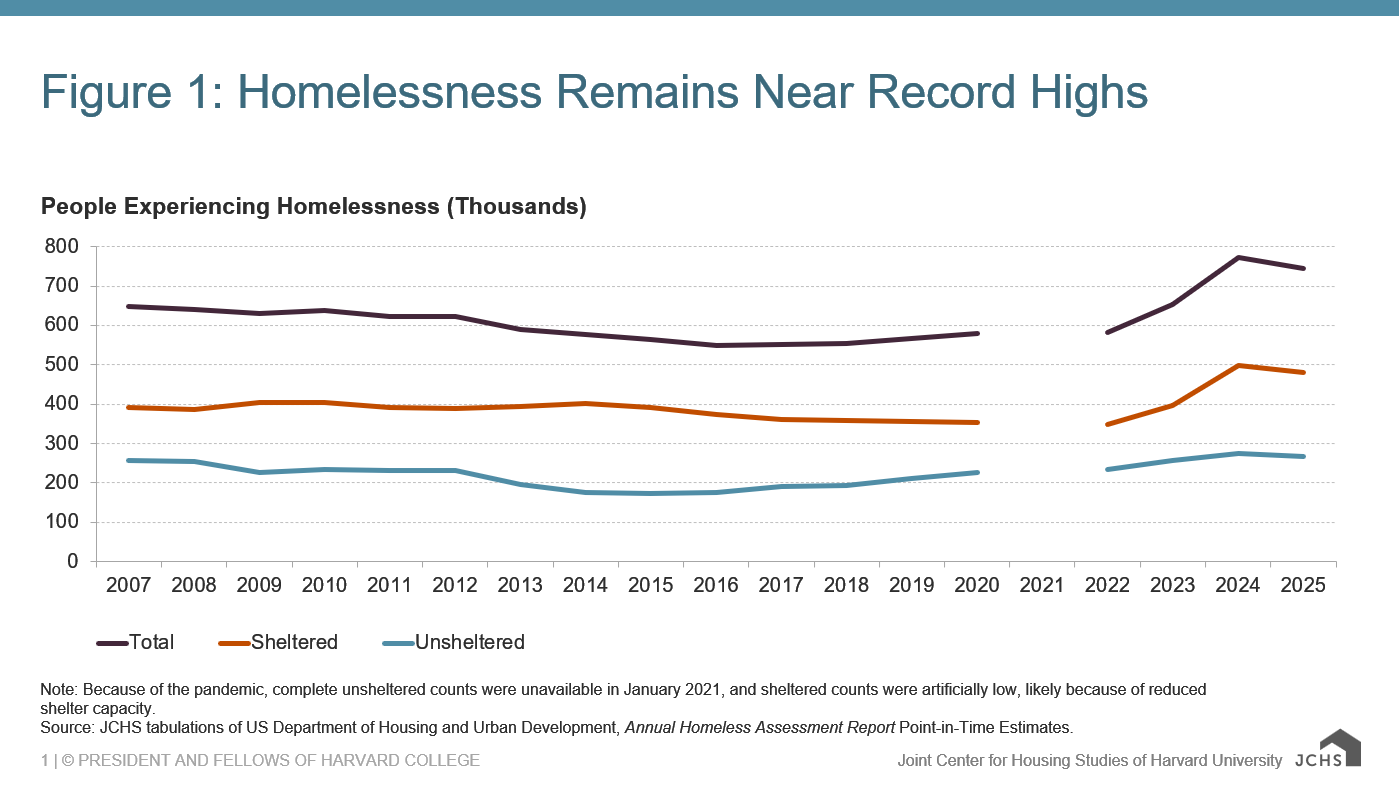
Note: Because of the pandemic, complete unsheltered counts were unavailable in January 2021, and sheltered counts were artificially low, likely because of reduced shelter capacity.
Source: JCHS tabulations of US Department of Housing and Urban Development, Annual Homeless Assessment Report Point-in-Time Estimates.
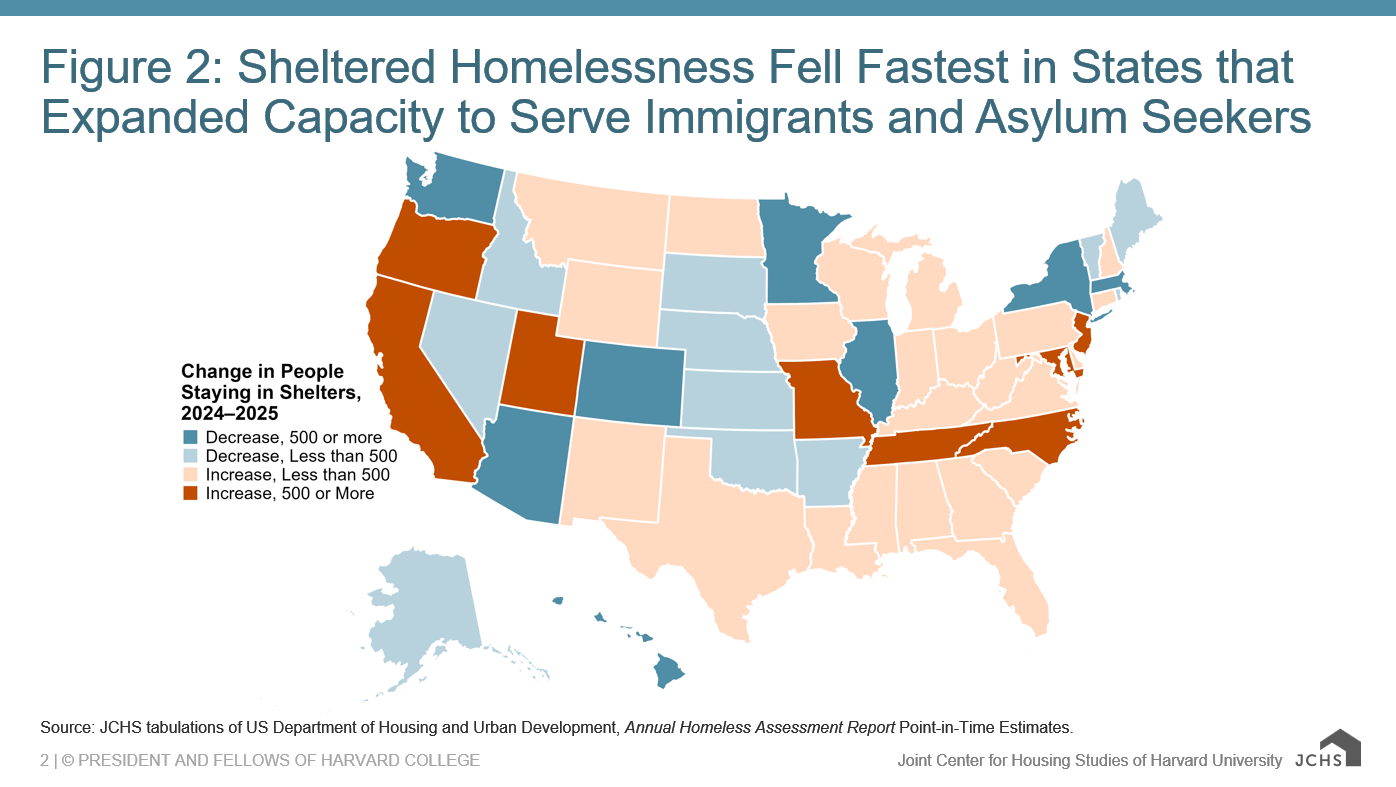
Lower levels of sheltered homelessness accounted for most of the overall decrease in last year’s counts. At the beginning of 2025, 479,330 people were staying in shelters. The number of people experiencing sheltered homelessness had fallen by 17,920 (4 percent) in one year. Some of the largest decreases in sheltered homelessness came in states that had stood up extra resources to accommodate increased demand from immigrants and asylum seekers (Figure 2), including New York (-12,680), Illinois (-10,670), Colorado (-2,310), and Massachusetts (-1,160). Hawaii also posted a substantial decrease of 4,810 people staying in shelters, following a temporary spike in emergency shelter use following the Maui wildfires. Large decreases in sheltered homelessness in a handful of states offset the increases that occurred in most states, including North Carolina (3,610) where Hurricane Helene destroyed thousands of homes. Further, the number of people staying in shelters remains well above pre-pandemic levels with a 124,950-person increase (35 percent) over five years.
Figure 2: Sheltered Homelessness Fell Fastest in States that Expanded Capacity to Serve Immigrants and Asylum Seekers
Source: JCHS tabulations of US Department of Housing and Urban Development, Annual Homeless Assessment Report Point-in-Time Estimates.
Unsheltered homelessness also fell modestly, breaking a nine-year upward trend. In 2025, 266,320 people were sleeping in places not intended for human habitation. This was a decrease of 7,900 people (3 percent). California had the largest drop in unsheltered homelessness at 8,390, which that state attributed to concerted efforts to invest in permanent supportive housing and reduce encampments.
Veteran homelessness continued to fall last year, reflecting that it has been a key policy priority since 2010 and heavily supported by Housing First programs. In the last 15 years, the number of veterans experiencing homelessness has dropped by 56 percent to a record low of 32,500. According to the US Department of Veterans Affairs, 85 communities and three states across the country have functionally ended veteran homelessness by using coordinated entry systems and pairing permanent housing with voluntary services.
The decrease in overall homelessness, however, masks a longer-term rise in chronic homelessness (Figure 3). Chronic homelessness is a subset of unsheltered homelessness and includes people with a disability who have either been continuously homeless for at least a year or have had at least four periods of homelessness over the last three years amounting to a total of at least a year. Nearly 170,000 people in the US were chronically homeless in 2025, a small increase of 1,480 from 2024. Last year’s gain extends the streak of increases in people experiencing chronic homelessness since 2016, and brings the total increase to 83,340, a near doubling over this period. The continual rise in chronic homelessness reflects the ongoing shortage of affordable homes as well as the insufficient support for people with disabilities.
Figure 3: Chronic Homelessness Continued Its Upward Trend
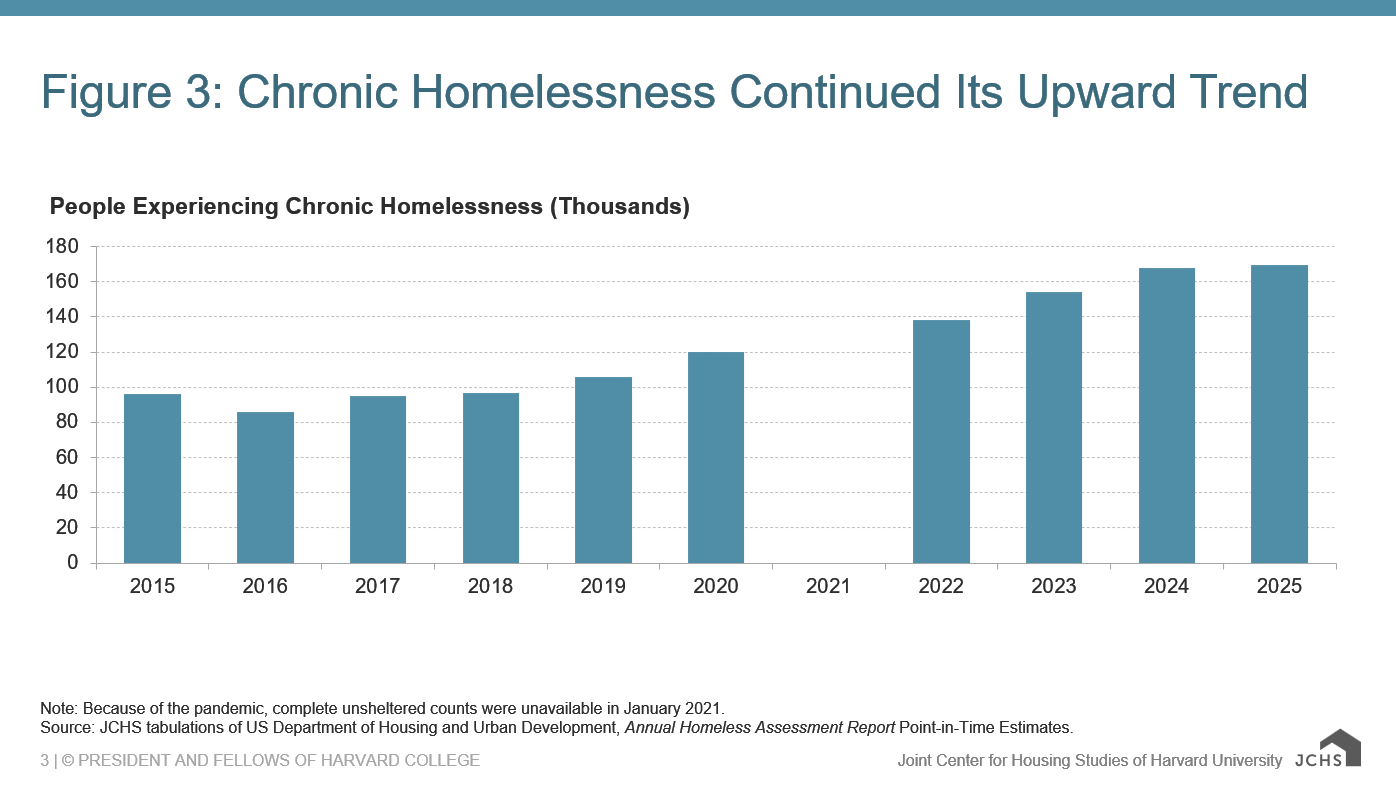
Note: Because of the pandemic, complete unsheltered counts were unavailable in January 2021.
Source: JCHS tabulations of US Department of Housing and Urban Development, Annual Homeless Assessment Report Point-in-Time Estimates.
As homelessness remains near record highs, the resources to prevent and address homelessness are at risk. Policy at the federal level has shifted away from Housing First, an approach that prioritizes housing people and providing supportive services without requiring treatment for mental health or substance use challenges. Subsequent funding notices have emphasized a turn away from permanent supportive housing. Along with the expiration of American Rescue Plan Act funds, the Continuums of Care and providers across the country that serve people experiencing homelessness face an increasingly uncertain environment. Ongoing unaffordability, a shortage of assistance for the lowest-income households, and a difficult economic landscape will put more households at greater risk of homelessness as the resources to address these challenges fail to meet the need.


