Housing Unaffordability Soared to New Highs in 2024

The number of cost-burdened households rose to record highs in 2024 as housing affordability remained a widespread challenge. According to Center estimates of newly released American Community Survey data, 43.5 million households were cost burdened in 2024, dedicating more than 30 percent of their income each month to housing costs (Figure 1). An additional 589,000 households were cost burdened compared to the year prior, bringing the total increase since 2019 to a staggering 6.4 million and leaving one-third (33 percent) of households with cost burdens. In another historic high, 21.6 million households, or 16 percent of all households, were severely burdened in 2024, spending more than half of their income on housing.
Figure 1: The Number of Cost-Burdened Households Reached New Heights in 2024
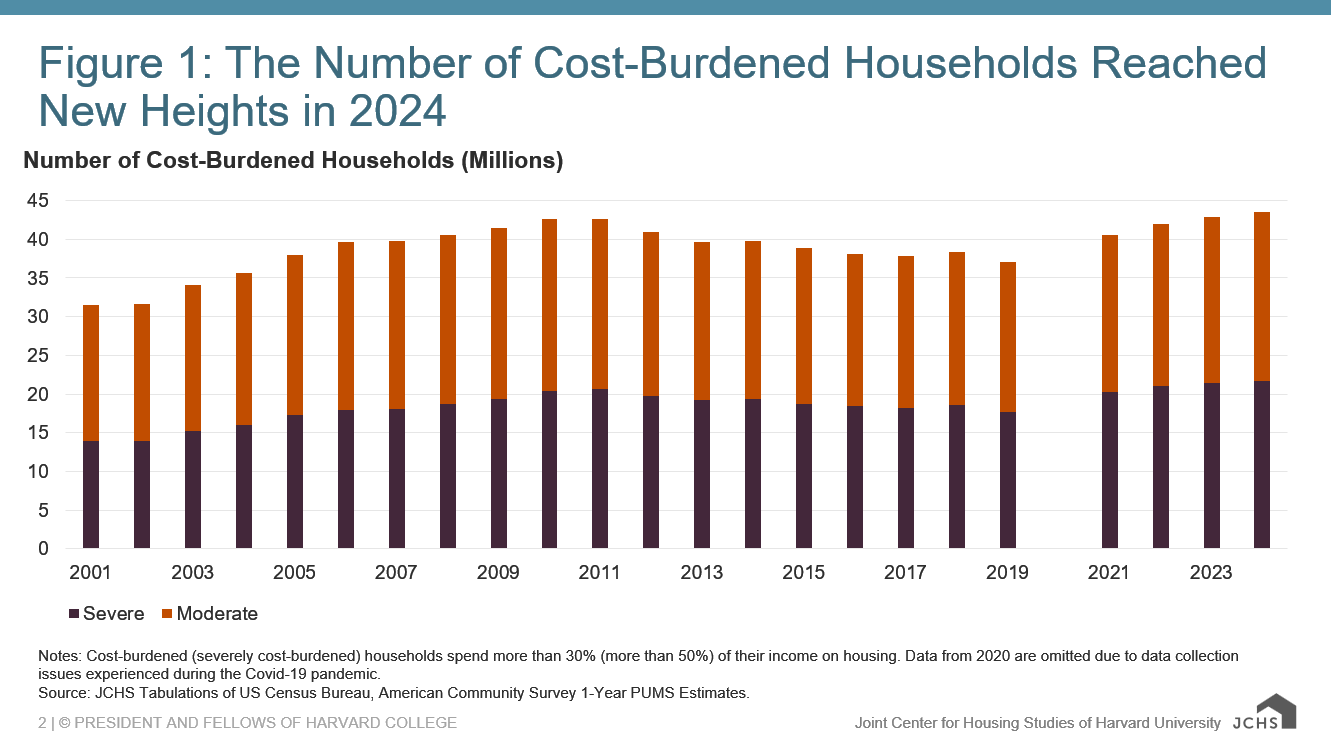
Notes: Cost-burdened (severely cost-burdened) households spend more than 30% (more than 50%) of their income on housing. Data from 2020 are omitted due to data collection issues experienced during the Covid-19 pandemic.
Source: JCHS tabulations of US Census Bureau, American Community Survey 1-Year PUMS Estimates.
As affordability continued to deteriorate, the number of cost-burdened homeowners rose to its highest level since 2011. Fully 20.7 million homeowner households faced cost burdens in 2024 (24 percent of all homeowners), an increase of 419,000 households annually and 4.0 million since before the pandemic (Figure 2). Some of this change was due to demographic shifts as the population ages; roughly half of newly burdened households were headed by older adults. As older adults retire or limit working hours, incomes fall. Even for older adults who own their homes free and clear, rising non-mortgage costs (like insurance, utilities, or property taxes) become a greater concern. Indeed, median housing costs grew by 35 percent since 2019 for households that owned their homes free and clear, compared to 25 percent for all homeowners, while homeowner incomes rose by only 23 percent.
Figure 2: Homeowner Affordability Continued to Worsen as Renter Burdens Reached Another Record High
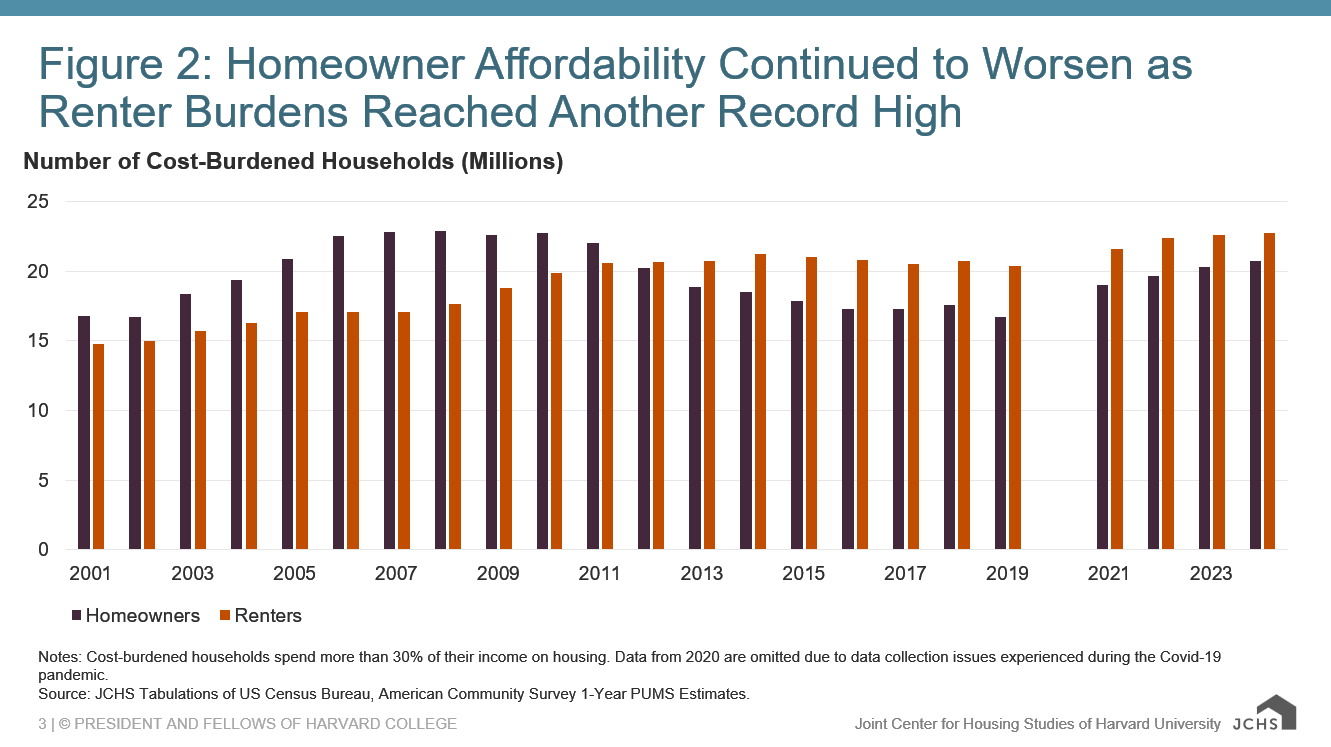
Notes: Cost-burdened households spend more than 30% of their income on housing. Data from 2020 are omitted due to data collection issues experienced during the Covid-19 pandemic.
Source: JCHS tabulations of US Census Bureau, American Community Survey 1-Year PUMS Estimates.
The number of cost-burdened renter households also grew to a new all-time high. There were 22.7 million cost-burdened renter households (49 percent of all renters) in 2024, setting a record high for the fourth consecutive year. There were 170,000 more burdened renters compared to the year prior, and 2.3 million more than in 2019. Differential housing costs and income growth since the start of the pandemic contributed to unaffordability; between 2019 and 2024, renters’ median housing costs rose by 38 percent while incomes increased by just 28 percent.
The share of homeowner households with cost burdens rose for all income groups but grew fastest for those with moderate incomes, as rising costs impacted those up the income scale. Nearly a third (31 percent) of homeowners earning between $45,000 and $74,999 were burdened in 2024, up by 1.1 percentage points on a yearly basis (Figure 3). And fully 45 percent of homeowners earning between $30,000 and $44,999 were burdened, up 0.9 percentage points annually. But the greatest increase in burden prevalence since the start of the pandemic was among lower-income homeowners. In 2024, fully three-quarters of homeowners with incomes under $30,000 were cost burdened, up 5.7 percentage points since 2019.
Figure 3: Affordability Has Worsened Most for Lower-Income Homeowners and Middle-Income Renters
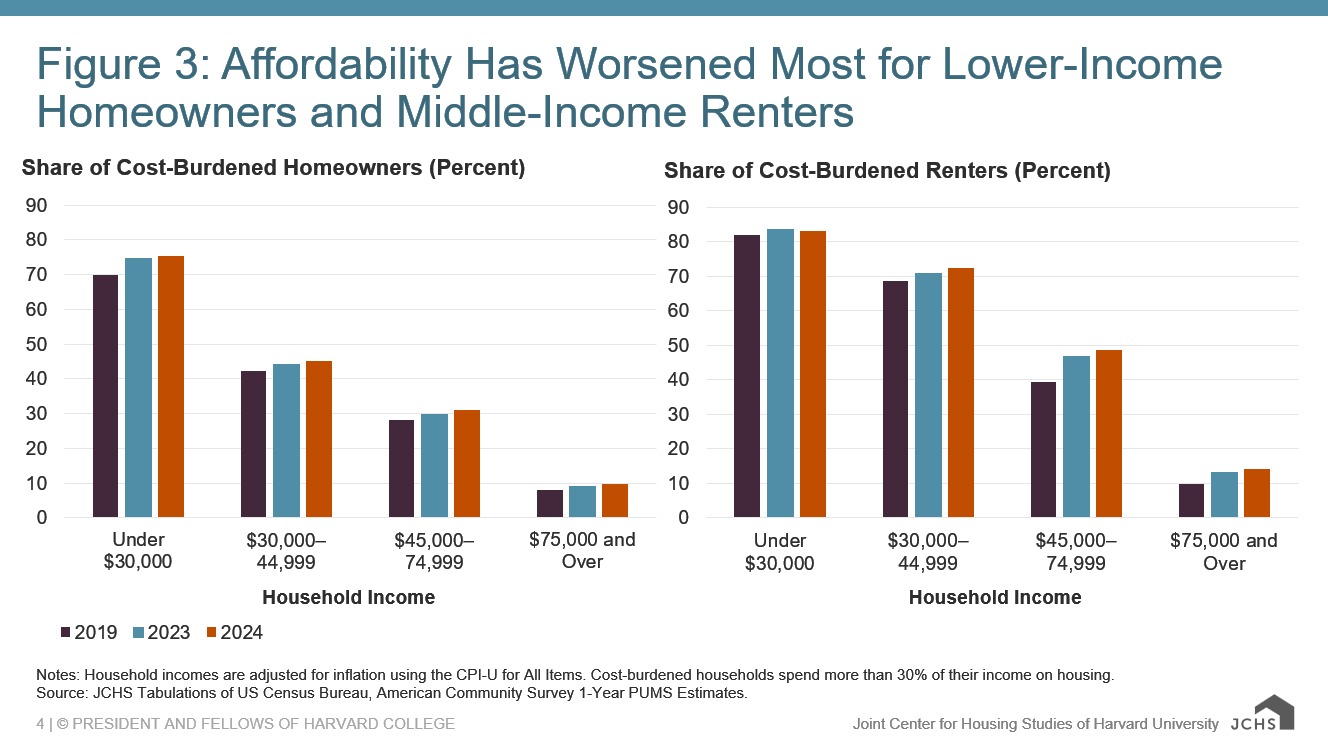
Notes: Household incomes are adjusted for inflation using the CPI-U for All Items. Cost-burdened households spend more than 30% of their income on housing.
Source: JCHS tabulations of US Census Bureau, American Community Survey 1-Year PUMS Estimates.
The share of cost-burdened renters continued to rise most rapidly among middle-income households. From 2023 to 2024, the share of burdened renters with incomes between $45,000 and $74,999 grew by a substantial 2.1 percentage points, to 49 percent of households. Since 2019, the share of middle-income renters facing cost burdens has increased an incredible 9.5 percentage points, as rent hikes in the wake of the pandemic increasingly impacted households at higher incomes. Even the highest-income renters weren’t immune to growing unaffordability; the share of burdened renters making at least $75,000 annually jumped 4.1 percentage points (to 14 percent of households) between 2019 and 2024. In contrast, the share of burdened lower-income renters didn’t have much room to grow, rising by just 1.1 percentage points since 2019 to 83 percent, as renters earning less than $30,000 have consistently shouldered the greatest affordability challenges.
Households of color also continued to be burdened at higher rates, especially compared to white households, due in part to a legacy of discrimination in housing, employment, and education. Among homeowners, the share of cost-burdened households was greatest for Black and Hispanic owners, at 32 percent and 29 percent, respectively. In addition, elevated shares of Asian (27 percent), multiracial (26 percent), and Native American (25 percent) homeowners were burdened, while this was true of only 22 percent of white homeowners. Similar disparities existed among renters. Over half of Black (57 percent) and Hispanic (54 percent) renters lived in unaffordable living arrangements, compared to 50 percent of multiracial renters, 45 percent of white renters, and 44 percent of Native American and Asian renters.
As housing costs continue to climb, households are facing affordability pressures in record numbers. Housing assistance remains an essential lifeline for lower-income renters facing the worst of the affordability crisis. For older, lower-income homeowners, levers to offset rising non-mortgage costs like property tax abatements, energy assistance, and home weatherization programs are also vital. To benefit households up and down the income scale, state and local governments can reform local zoning laws and encourage more cost-effective construction methods, like modular and manufactured housing. This could encourage more housing construction and a diversity of housing types to help ease the ongoing supply shortfalls that have contributed to record unaffordability.


