Homebuilding and Remodeling Depend on Immigrant Labor in Major Metros

In metro areas with the highest levels of homebuilding and remodeling, immigrants play a key role in the supply of labor. There is a disproportionately high share of foreign-born workers in the construction trades nationally, and that share is even higher in these communities. The recent slowdown in immigration will limit foreign-born labor for the trades, however, potentially worsening chronic labor shortages and constraining the ability to build and remodel housing.
While immigrants make up about one in five workers nationally, they make up one in three workers in the construction trades, defined here as those working in skilled trade occupations. Foreign-born trades workers were most commonly construction laborers or carpenters in 2024, but they played an outsized role in other occupations. Three-fifths of plasterers and drywall installers were foreign-born in 2024, as were half of all roofers, painters, and carpet, tile, and floor installers.
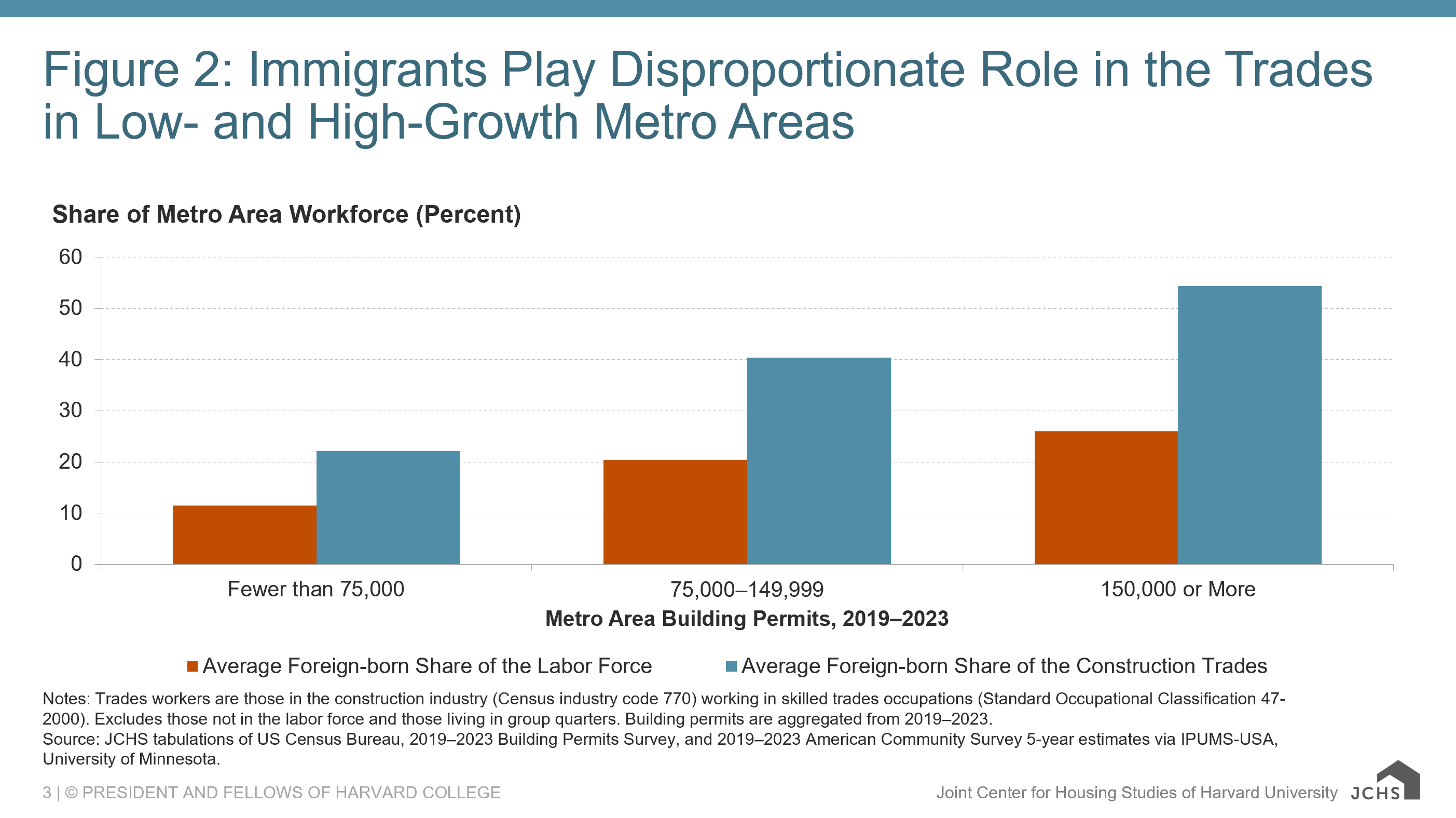
Immigrants account for an even larger share of the construction trades workforce in the top homebuilding metros than they do nationwide (Figure 1). In the seven metros that issued at least 150,000 building permits from 2019–2023, an average of 54 percent of the trades workforce was foreign‑born. The Dallas–Fort Worth–Arlington, TX metro led the nation in homebuilding with nearly 350,000 permits, and fully 61 percent of its trades workforce was foreign‑born. Metros that issued 75,000–149,999 permits had an average foreign‑born share of 40 percent, while those with fewer than 75,000 permits averaged 22 percent. Even in these relatively lower-building metros, the foreign-born share of the trades remained disproportionate to the foreign-born share of the overall labor force (Figure 2).
Figure 1: Immigrants Play Key Role in Housing Supply in Top Homebuilding Metros
Notes: Trades workers are those in the construction industry (Census industry code 770) working in skilled trades occupations (Standard Occupational Classification 47-2000). Excludes those not in the labor force and those living in group quarters. Foreign-born trades shares are annual averages from 2019–2023. Building permits are aggregated from 2019–2023.
Sources: JCHS tabulations of US Census Bureau, 2019–2023 Building Permits Survey, and 2019–2023 5-year estimates via IPUMS-USA, University of Minnesota.
Figure 2: Immigrants Play Disproportionate Role in the Trades in Low- and High-Growth Metro Areas
Notes: Trades workers are those in the construction industry (Census industry code 770) working in skilled trades occupations (Standard Occupational Classification 47-2000). Excludes those not in the labor force and those living in group quarters. Building permits are aggregated from 2019–2023.
Sources: JCHS tabulations of US Census Bureau, 2019–2023 Building Permits Survey, and 2019–2023 American Community Survey 5-year estimates via IPUMS-USA, University of Minnesota.
Immigrants also account for a high share of the construction trades workforce in top remodeling metros. In the five metros with the highest remodeling expenditures, fully 57 percent of the trades workforce was foreign-born, on average from 2019–2023 (Figure 3). For the remaining 15 metro areas with remodeling expenditures data available, the average foreign-born share of the trades was 36 percent. This relationship reflects the importance of immigrants in metros that may have high demand for the trades even without similarly high demand for homebuilding. One notable example is Chicago, which ranks 21st in building permits, but 4th in remodeling expenditures, and in which 38 percent of the trades workforce was foreign-born in 2019–2023.
Figure 3: Immigrants Are Central to Trades in Top Remodeling Metros
Notes: Data are for the 20 metros available in the 2023 AHS, which includes the 15 largest by population. Trades workers are those in the construction industry (Census industry code 770) working in skilled trades occupations (Standard Occupational Classification 47-2000). Excludes those not in the labor force and those living in group quarters. Foreign-born trades shares are annual averages from 2019–2023. Remodeling expenditures are from 2023.
Sources: JCHS tabulations of US Department of Housing and Urban Development and US Census Bureau, 2023 American Housing Survey, and US Census Bureau, 2019–2023 5-year estimates via IPUMS-USA, University of Minnesota.
The substantial role of immigrant labor in these metros is in part due to chronic labor shortages in the construction trades workforce and the higher likelihood of immigrants to move in response to local labor markets. With the recent steep slowdown in immigration, new labor supply will be limited for the trades, which already struggle to attract workers from the broader labor force. This could further constrain the construction industry’s ability to supply and remodel housing in these communities and beyond.


