Declining Immigration Undermines Urban and Rural Population Growth

Declining immigration is undermining population growth, according to our recently released State of the Nation’s Housing report, making communities more reliant on domestic migration and natural change (births minus deaths) to grow their populations. In 2025, these two components (domestic change) varied sharply across county types—and that variation will determine which communities can sustain growth as immigration continues to decline. Population growth is most vulnerable to decline from reduced immigration in large metro urban counties due to steep losses from domestic migration, and in rural counties due to steep losses from natural change. Large metro suburban and smaller metro area counties are better positioned for modest but sustained growth due to gains from both components of domestic change.
With the help of immigration, every county type saw aggregate population growth in 2025. Without it, there would have been population loss in large metro urban counties, only marginal growth in rural counties, and growth in suburbs and smaller metros would be cut nearly in half. Large metro urban counties had steep net domestic outflow of 668,000 people that offset their relatively strong natural growth of 347,000, resulting in a loss of 321,000 people from domestic change (Figure 1). In contrast, non-metro counties—which are largely rural—had net domestic inflow of 119,000 that just barely offset their natural loss of 95,000, resulting in domestic growth of just 24,000 people. Large metro suburban counties saw growth from both net domestic inflows (243,000) and natural growth (181,000), resulting in domestic growth of 424,000 people. Smaller metro counties also had growth from both components, with slightly stronger net inflows (306,000) and weaker natural growth (86,000) than their large metro suburban counterparts, resulting in domestic growth of 392,000 people. These domestic growth levels account for around 60 percent of overall population growth in large metro suburban and smaller metro counties and 30 percent of growth in rural counties.
Figure 1: Without Immigration, Urban and Rural Areas Are Most Vulnerable to Population Loss
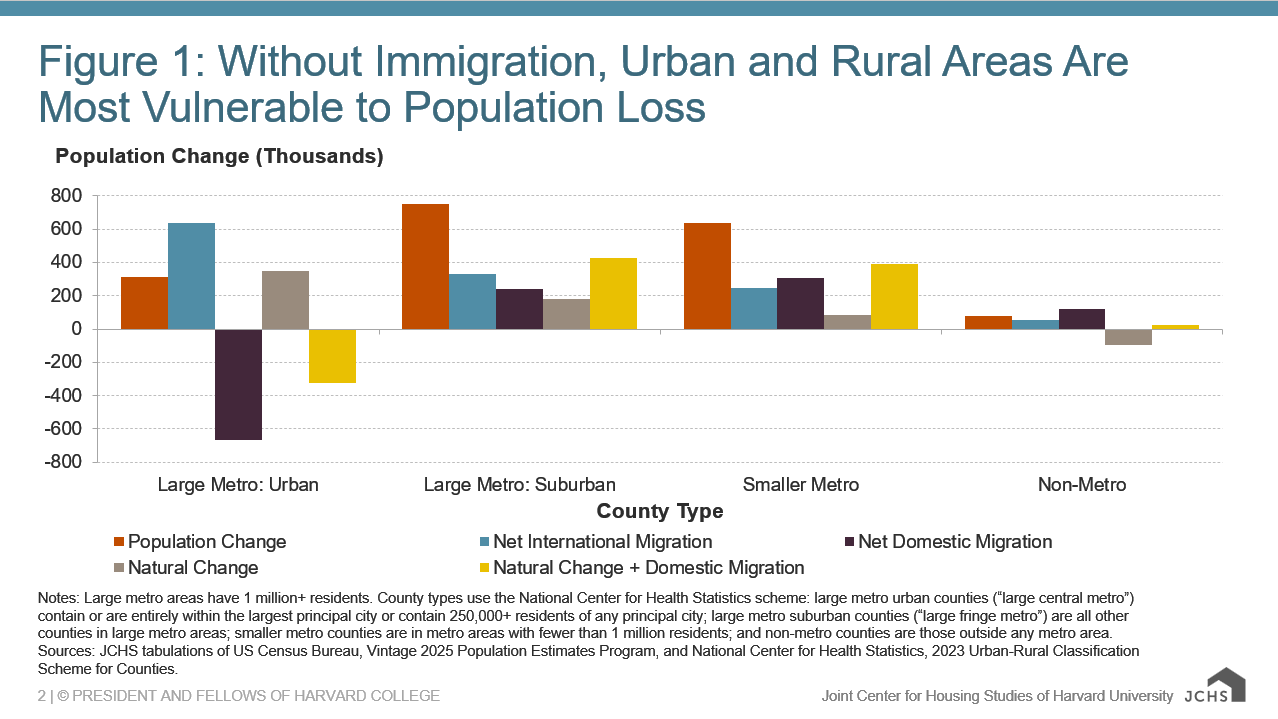
Notes: Large metro areas have 1 million+ residents. County types use the National Center for Health Statistics scheme: large metro urban counties (“large central metro”) contain or are entirely within the largest principal city or contain 250,000+ residents of any principal city; large metro suburban counties (“large fringe metro”) are all other counties in large metro areas; smaller metro counties are in metro areas with fewer than 1 million residents; and non-metro counties are those outside any metro area.
Sources: JCHS tabulations of US Census Bureau, Vintage 2025 Population Estimates Program, and National Center for Health Statistics, 2023 Urban-Rural Classification Scheme for Counties.
This variation in domestic change can be seen clearly in large metro areas across the country when mapping population change according to these two components alone (Figure 2). The urban cores of large metros saw substantial aggregate loss from domestic change, while their suburbs had strong aggregate gain. Harris County, Texas (containing Houston), for example, lost population because net domestic outflow of 43,000 exceeded its natural growth of 35,000, resulting in domestic loss of around 8,000 people. On average, the suburban counties of the Houston metro had domestic growth of 7,000 people. Indeed, several of these counties were among the fastest growing in the country in 2025. This pattern repeats in large metro areas nationwide, with one regional exception: suburban counties in the Northeast had aggregate domestic loss, driven by net domestic outflows.
Figure 2: Urban Counties Lose Population from Domestic Change While Suburban and Smaller Metro Counties Gain
Counties in smaller metro areas also showed gains from domestic change, in all regions except again for the Northeast. Examples include Hamilton County, Tennessee (Chattanooga) in the South; Cass County, North Dakota (Fargo) in the Midwest; and Ada County, Idaho (Boise) in the West—in contrast to Hampden County, Massachusetts (Springfield) in the Northeast. Smaller metro counties gained 292,000 people from domestic change in the South, 79,000 in the West, and 31,000 in the Midwest, while these counties lost 10,000 people overall in the Northeast, due to both net domestic outflows and natural loss. While rural counties saw aggregate growth from domestic change, whether a rural county gained or lost from these components depended heavily on its region. In aggregate, rural counties in the South gained 38,000 people from domestic change in 2025, while those in the Northeast, Midwest, and West all saw losses of 7,000, 6,000, and 500 people, respectively, driven by natural losses that exceeded net domestic inflows in each region.
The components of domestic change, however, are themselves weakening. Interstate migration declined in 2024 for the second consecutive year, according to the American Community Survey. Natural change in 2025 was well below the average from the previous decade, having failed to substantially recover from the pandemic, and the Congressional Budget Office projects it will turn negative nationally by 2030. As our State of the Nation's Housing report notes, these headwinds are already weighing on housing demand and with all three components of population change slowing, large metro urban and rural counties are most likely to feel the slowdown soonest and most sharply.
Image: Downtown Houston, Texas.


