Expanding Housing Options: Reforms to Legalize Missing Middle Housing in Massachusetts

Missing middle housing refers to a house scale between a single-family home and a mid-rise apartment building. Often located in existing neighborhoods near jobs, transit, amenities, and infrastructure, missing middle homes can be more affordable, their locations more walkable, and their environmental footprints more sustainable than alternative housing types. In response to the need for 222,000 new homes in the next decade, Massachusetts can use missing middle housing as a powerful tool to incrementally infill vacant or under-capacity lots in cities, towns, and neighborhoods. However, middle homes such as duplexes, triplexes, townhouses, and cottage clusters are routinely banned due to strict local zoning rules.
Figure 1: “As-of-Right” Approval of Missing Middle Homes in Massachusetts
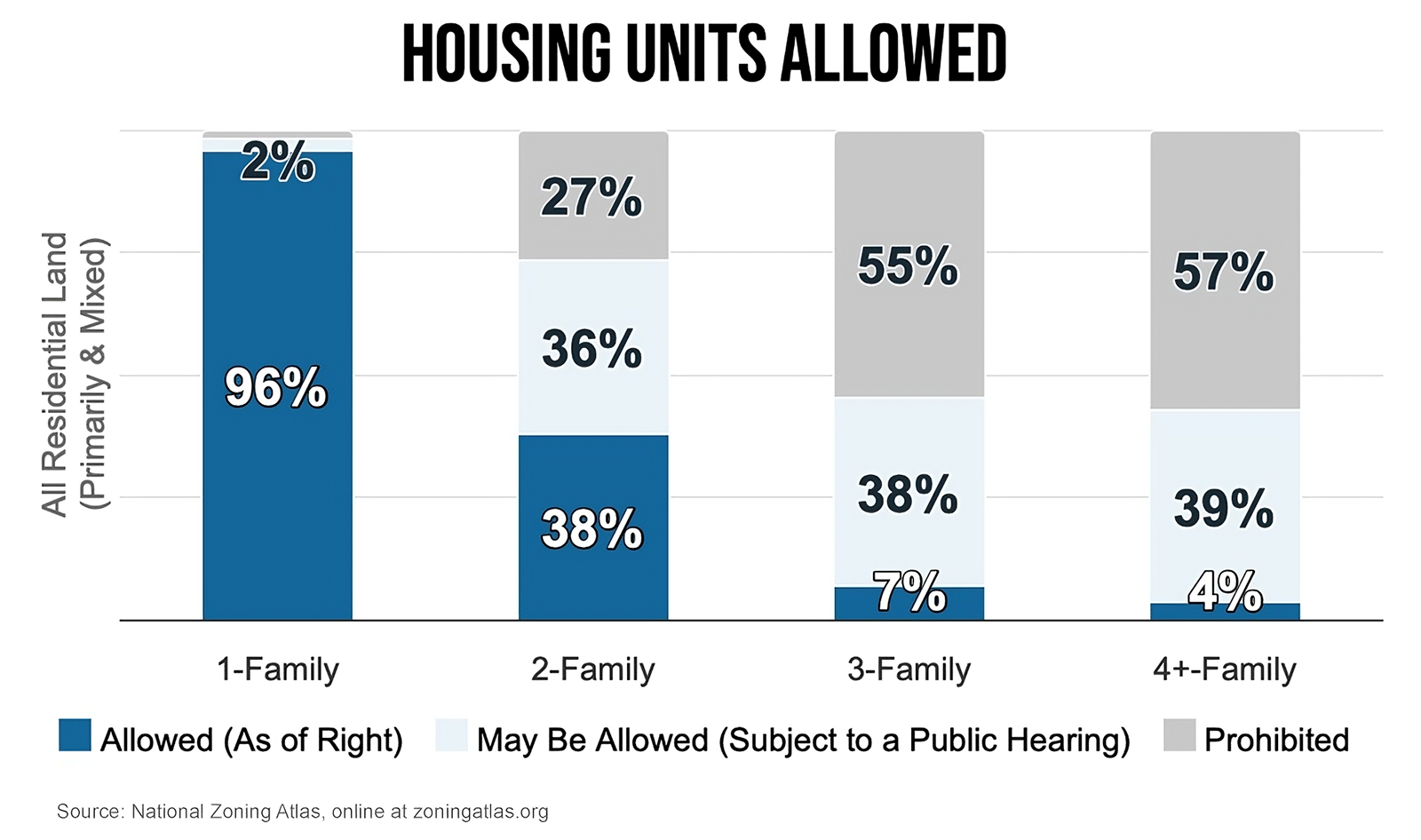
Note: “As-of-right” refers to a housing development that meets all local zoning without the need for special permits, variances, or discretionary review, and is used interchangeably with “by-right.”
Source: National Zoning Atlas, online at zoningatlas.org
Our series of papers, Unlocking the Missing Middle, examines three aspects of middle housing. As we explained in Part 1, missing middle homes composed the original fabric of many Massachusetts communities, but post-World War II zoning aimed at limiting density and creating homogenous suburban communities made these homes nearly impossible to build and resulted in two housing types becoming dominant: the single-family home and the mid-to-high-rise apartment building. In Part 2, “Legalizing Missing Middle Housing—Recommended Reforms for Massachusetts,” we offer a suite of policy and regulatory proposals to make missing middle homes legal again under local zoning ordinances. We explore success stories from other states and municipalities that in recent years have rallied political and community support for policy changes to re-legalize small-scale multifamily homes.
The severity of the housing crisis demands coordinated and comprehensive action across regional markets, and a number of states have addressed zoning reform at a statewide level to enable more diverse housing types in more places. Oregon was the first state to legalize missing middle housing in 2019, and nine other states have followed suit with variations of statewide policy and regulatory reform.
Our recommended zoning and other regulatory reforms for Massachusetts fall into six categories:
- Legalizing Missing Middle Housing Types in All Residential Areas—To start, Massachusetts should legalize missing middle home types up to five units in all residential areas across the state (allowing for density gradations depending on infrastructure or population size) and provide a model code to help municipalities adopt state preemptions. In addition, streamlining adaptive reuse provisions will remove hurdles to converting existing buildings to missing middle homes.
- Removing or Decreasing Residential Parking Minimums—Requirements dictating a minimum number of parking spaces per dwelling unit drive up development costs and consume valuable land, making smaller-scale developments less feasible. Recommendations include reducing parking minimums to no more than one space per unit in all residential districts; eliminating parking minimums or considering parking maximums in transit-accessible areas; encouraging shared parking models; and considering charging parking fees for new parking stalls to ensure that excessive parking does not stymy missing middle construction on infill lots.
- Reducing Minimum Lot Sizes—Reducing minimum lot size requirements to 2,000 square feet or less will enable the construction of smaller home types, making better use of existing land. Streamlining processes for subdividing lots is also critical for enabling affordable small-scale ownership models, such as townhomes.
- Increasing Lot Coverage and Reducing Setback Restrictions—Lot coverage and setback rules inhibit the construction of missing middle housing by overly restricting buildable land. Recommendations include increasing allowed lot coverage for missing middle homes to between 30 and 60 percent or more; allowing flexible, reduced, or zero setback requirements, especially in urban and transit-accessible areas; increasing allowable building height up to four stories in larger municipalities and up to two stories in smaller towns; and incorporating design best practices to ensure privacy and comfort of dense missing middle homes.
- Streamlining the Development Review Process—Missing middle housing projects are often subject to the same byzantine review processes as larger-scale developments. Enabling by-right construction and pre-approved house plan sets will eliminate the need for additional project review. Reducing development fees proportionally for smaller-scale projects, fast-tracking project review timelines, and exploring online or automated permit navigation services will also help streamline the review process.
- Reforming Building Codes that Limit Missing Middle Housing—Creating a building code carveout that safely exempts structures up to six units from the default commercial building code will reduce the time, cost, and complexity to build missing middle homes. Additionally, increasing code flexibility to allow a single staircase in residential buildings up to six units will open up access to smaller lots in more walkable, denser places.
The first recommendation is the most obvious and most important because it is impossible, or at least costly and inefficient, to build new missing middle home types at a density that is not allowed by-right through local zoning. However, it will take more than legalizing middle homes in name alone to ensure they can actually be built, which is why these recommendations should be seen as a package, with each playing a role in building smaller, denser, and more diverse housing.
Success stories from other states who have passed landmark middle housing legislation highlight a few common lessons:
- Take an incremental approach;
- Rely on broad political coalitions and strong legislative champions;
- Allow for some degree of local control;
- Use pragmatic arguments; and
- Employ economic messaging rather than moral arguments.
We hope that Massachusetts legislators will find inspiration and action steps from these success stories and policy recommendations to build a future with more abundant housing.
Part 3 of our series will identify additional strategies and resources beyond zoning and regulatory policy—including financing, advocacy, construction innovation, and test fits—that are necessary for a robust middle housing market.


