
Revised April 15, 2026
Cambridge, MA – Annual spending on improvements and maintenance to owner-occupied homes is expected to gradually slow through 2026, according to the latest Leading Indicator of Remodeling Activity (LIRA) from the Remodeling Futures Program at the Joint Center for Housing Studies of Harvard University. The LIRA projects that year-over-year growth in home renovation and repair spending will be 2.1 percent in the middle of this year before easing to 1.6 percent growth by the end of the year.
“Single-family home sales and permitting activity have picked up modestly from very low levels, which should support a nominal increase in remodeling activity this year,” says Rachel Bogardus Drew, Director of the Remodeling Futures Program at the Center. “Even with some deceleration later in the year, overall annual homeowner spending on improvements is expected to reach $518 billion by the end of 2026.”
“Remodeling trends closely track the health of the broader housing market,” says Chris Herbert, Managing Director of the Center. “If interest rates begin to ease, that could provide a much-needed boost to both housing construction and retail sales of building materials, which for now continue to pose significant headwinds to homeowner improvement spending.”
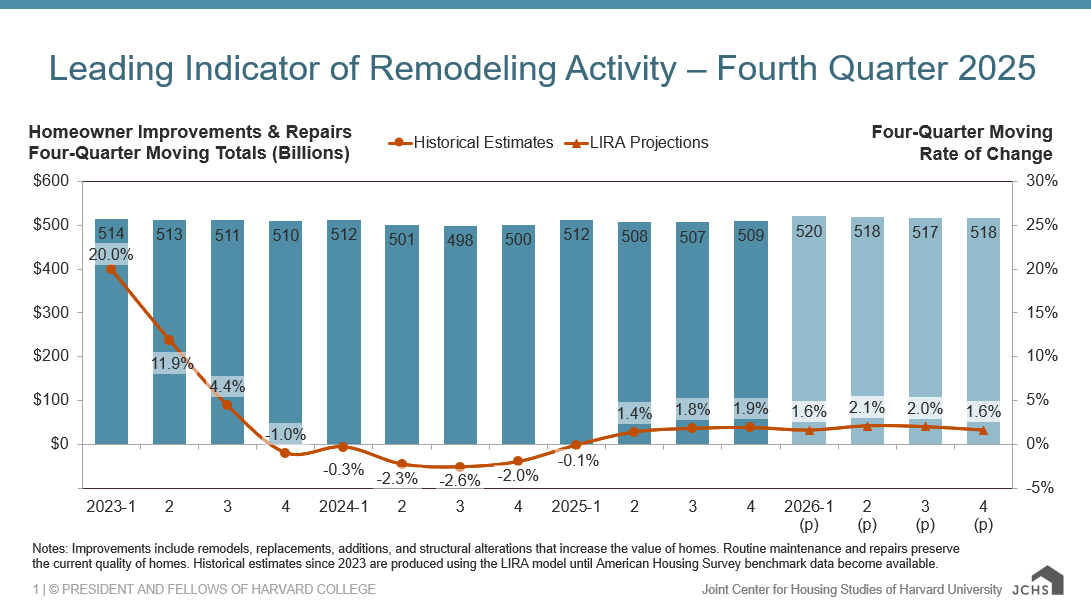
Click image for full-size chart.
PLEASE NOTE: Due to delayed and missing data resulting from the 2025 federal government shutdown, adjustments were made to the January 2026 LIRA methodology. For the October 2025 CPI (BLS), we applied the year-over-year change in the Cleveland Fed’s Revised 16% Trimmed Mean CPI to the October 2024 CPI. For November 2025 new single-family housing starts (Census), we applied the October 2024–2025 rate of change in starts to the November 2024 starts, consistent with our standard imputation method for the final month of each quarter. In addition, we used actual (rather than imputed) December values from the National Association of Realtors for existing single-family home sales and median sales price.
REVISION 4/15/26: This release replaces the prior 2025 Q4 release dated January 26, 2026 to correct an error in the formula used to estimate the annual rate of growth in remodeling spending for 2025 Q4 and 2026 Q1, which omitted some model inputs and elevated projected growth rates and remodeling spending in those quarters.
The Leading Indicator of Remodeling Activity (LIRA) provides a short-term outlook of national home improvement and repair spending to owner-occupied homes. The indicator, calculated from the annual rate-of-change of its components, is designed to project the annualized spending for the current quarter and subsequent four quarters, and is intended to help identify future turning points in the business cycle of the home improvement and repair industry. Originally developed in 2007, the LIRA was re-benchmarked in April 2016 to a broader market measure based on the biennial American Housing Survey.
The LIRA is released by the Remodeling Futures Program at the Joint Center for Housing Studies of Harvard University in the third week after each quarter’s closing. The next LIRA release date has been postponed to May 5, 2026.
The Remodeling Futures Program, initiated by the Joint Center for Housing Studies in 1995, is a comprehensive study of the factors influencing the growth and changing characteristics of housing renovation and repair activity in the United States. The Program seeks to produce a better understanding of the home improvement industry and its relationship to the broader residential construction industry.
The Harvard Joint Center for Housing Studies strives to improve equitable access to decent, affordable homes in thriving communities. We conduct rigorous research to advance policy and practice, and we bring together diverse stakeholders to spark new ideas for addressing housing challenges. Through teaching and fellowships, we mentor and inspire the next generation of housing leaders.
MEDIA CONTACT:
Kerry Donahue, Director of Communications
(617) 495-7640, [email protected]

