Nearly a Quarter of Major Metros Are Precariously Positioned for Covid-19 Job Losses

While the COVID-19 pandemic is having substantial economic effects on renters throughout the United States, its impact could be particularly dramatic in the 23 major metropolitan areas that already faced severe affordability challenges and had high shares of renters working in at-risk industries. Using data from the 2018 American Community Survey, I examined the share of renters working in industries vulnerable to job losses and the share of renters that are severely cost burdened (spending more than half of their incomes on housing) in the 100 largest metropolitan areas in the country. By identifying metropolitan areas with existing economic vulnerabilities, this analysis shows where the unfolding crisis and resulting job losses may have the largest impact on rental markets.
Recent employment losses have been steep and have varied widely by industry. In their latest CES Highlights report, the Bureau of Labor Statistics reported that nonfarm employment fell by over 20 million jobs this April. In a recent blog post, my colleague Whitney Airgood-Obrycki used existing research to establish a list of industries that are likely to lose the most jobs in a COVID recession. According to her analysis, “at-risk” industries include retail, services, recreation, transportation and travel, and oil extraction, and renters in those jobs already had lower wages and high cost burdens. Because at-risk jobs are more common in some cities, and major metros across the country were unaffordable to many renters even before the pandemic, COVID-related job losses will have different impacts across metros.
In order to categorize the 100 largest US metros, I divided them into quartiles: the first at-risk jobs quartile represents the 25 metros with the lowest share of renters with at-risk jobs, while the fourth quartile represents the 25 metros with the highest shares. Metros were similarly categorized by share of severely cost-burdened renters with the fourth quartile being those with highest shares. I examined the at-risk jobs and severe cost burden measures separately and then highlighted metros that have high shares of both at-risk jobs and severe burdens. The full data table is available here (Excel).
FIGURE 1: METROS THROUGHOUT THE SOUTH AND WEST HAVE HIGH SHARES OF RENTERS WORKING AT-RISK JOBS
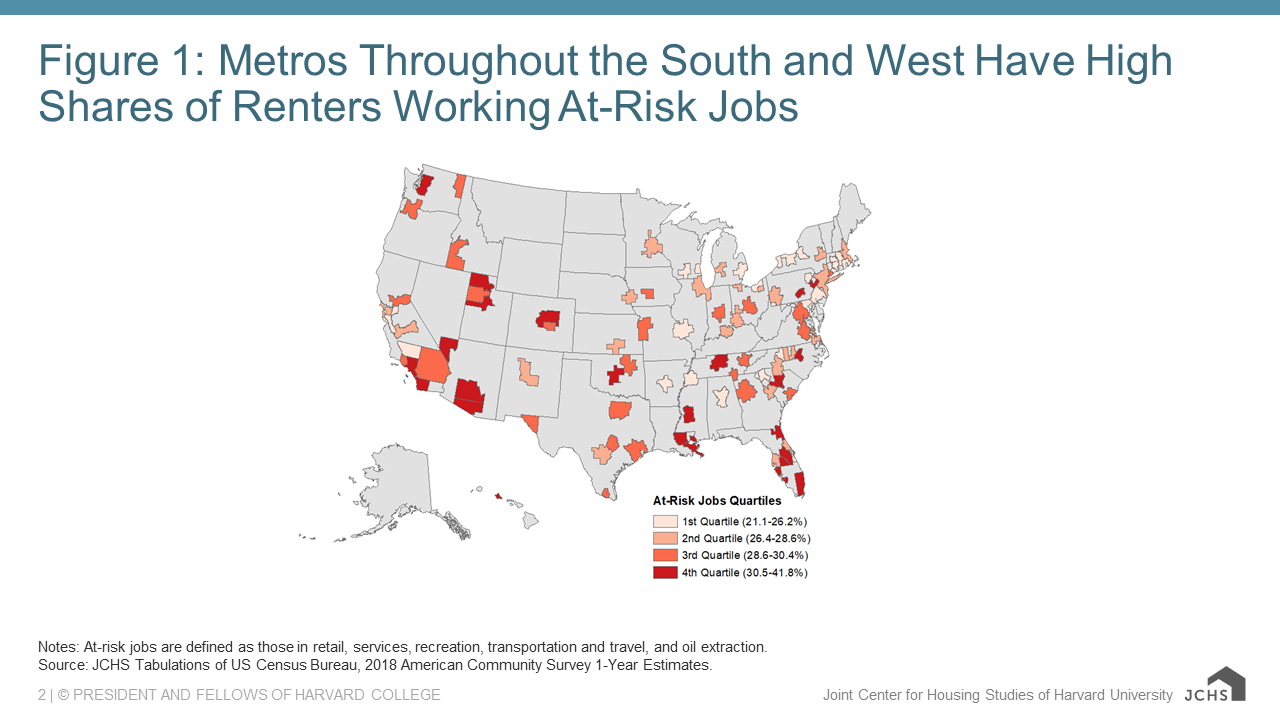
Notes: At-risk jobs are defined as those in retail, services, recreation, transportation and travel, and oil extraction.
Source: JCHS Tabulations of US Census Bureau, 2018 American Community Survey 1-Year Estimates.
When COVID hit, at-risk jobs were heavily concentrated in parts of the South and West (Figure 1). The share of renters working in these industries ranged from as high as 41.8 percent in the Las Vegas metro to as low as 21.1 percent in the Worcester, MA metropolitan area. The Las Vegas metro, a tourist hub, had the highest share of renters in at-risk jobs by three percentage points. The metros with the next highest shares of renters working precarious jobs were Provo, UT (38.8 percent), followed by Orlando (38.3 percent), Ogden, UT (35.3 percent), and Lakeland, FL (34.6 percent). The share of renters working at-risk jobs tended to be lower in the Midwest and parts of the East Coast. In the Midwest, Milwaukee ranked third from the bottom out of 100 metros for this measure. Only 22.3 percent of renters in Milwaukee worked in at-risk industries. And on the East Coast, Worcester, MA ranked last, with only 21.1 percent of renters working in at-risk industries. In addition, the shares of severely cost-burdened renters were particularly high in metros throughout South and West, according to an interactive map we released with our latest America’s Rental Housing report.

